Why Executive Teams Fail to Execute: The Alignment Trap
by Keith Brown, President & Owner, Siena Group
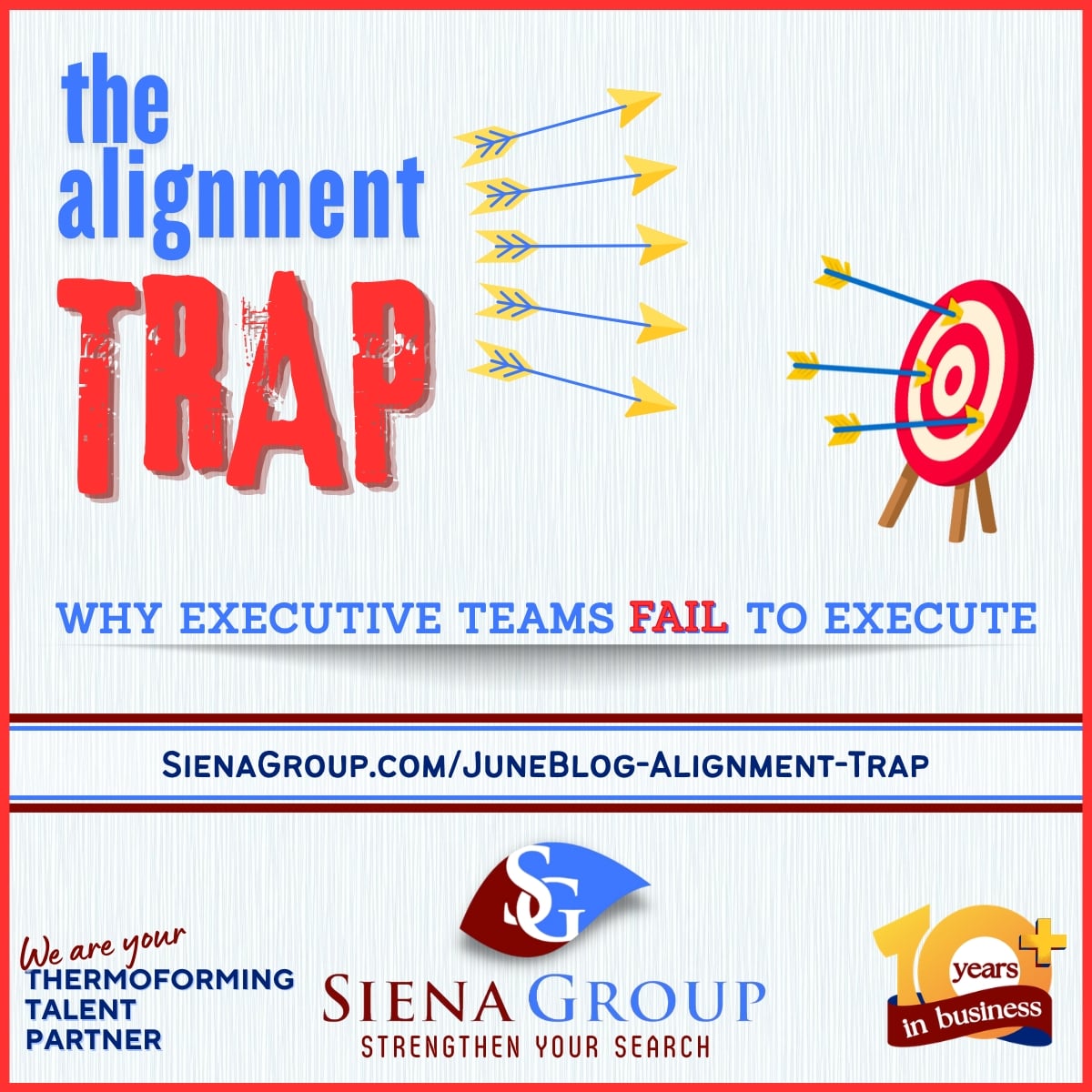
There is a great article in the most recent HBR Magazine edition titled The False Alignment Trap. In summary, the authors state that “Most organizational change efforts fail not because of poor execution but because senior leaders fall into a false alignment trap—believing they agree on why, what, and how to change when they actually do not.”

Over my years as part of leadership teams and in the many discussions I have with senior business leaders as their talent partner, I’ve seen and lived this very thing way too often.
As the authors get into the article, they utilize the word ‘transformation’ as the key focus of organizational change. This transformation effort goes awry due to lack of clarity and – ironically – alignment. Another phrase is synonymous in my opinion: “turnaround situation.” Without getting too philosophical, the reason a company is seeking a transformation typically means that something is going wrong. Sales are down. Market share is waning. Costs are up. These can be caused by both internal and external forces.
No matter the reason, the fact remains: something negative is happening that is large enough to generate concern and a need to make a fundamental change. My sense is that the 80/20 rule applies here. The majority of transformations are driven by negative situations like those listed above, while a smaller percentage result from positive ones, such as acquisitions, expansion, or rebranding.
In either case, the failures caused by ‘false alignment’ will hamstring change.
The Trap – “Alignment”
The HBR article states:
Every change program needs clear answers to a few seemingly obvious questions:
- Why are we changing our company?
- What are we changing about our company? (And what are we not changing?)
- How will the changes occur?
Executive teams often make the mistake of embarking on a transformation before everyone truly agrees on the specific answers to those questions. Worse, executives frequently behave as if they are much more in agreement than they really are.
Alignment and agreement are not the same.
HBR, The False Alignment Trap
The need for senior leaders to all be on the same page – and KNOW that they are all on the same page – is critical.
As we will see further on in the article, being on the same page doesn’t mean 100% agreement. And that is totally fine! But having clarity on the specifics and path forward is a must-have. Consensus building can be dangerous in executive meetings because groupthink can take hold, and that doesn’t allow for respectful dissent. What’s interesting is that the three questions above are simple and straightforward, yet they are difficult for a group of humans to all answer similarly!
Again from the article:
Common Causes of False Alignment:
HBR, The False Alignment Trap
- Executives don’t realize that they don’t agree. “False consensus effect.”
- Executives pretend to agree.
- Executives put off resolving their differences.
In my own experiences, I’ve found that number 2 is the sneaky pernicious one. There is a strong personality in the room, and people don’t want to cause problems. There are politics at play and caution is taken to not be the one that ‘stirs things up.’ It can be debilitating and frustrating, and it leads to a change program – either a transformation or a turnaround – that takes forever or fails altogether.
The Consequences of False Alignment
When executives don’t have a shared agreement on what is changing, why it’s changing, and how the change will occur, the teams tasked with actually executing the change program will struggle to deliver.
- Paralysis: lots of talk, no action.
- Hyperactivity: lots of action, no progress.
- Tunnel vision: lots of progress – on the wrong thing.
There are lots of ways to fail and they usually fall into one of the three types shown above. Whatever the method, the inability to address, correct, and affect true change will result in negative impacts.
The Fix – True Agreement
The authors found in their research that “the most successful executive teams use a five-step process.”
- Set clear parameters. Talk about motherhood and apple pie! This is as fundamental as it gets… but it apparently isn’t part of all transformations. Clarity on roles and responsibilities, decision-making authority, who’s in the room, and more are all critical. Gaining this information at the onset is imperative.
- Provoke an early exchange. The article does a good job of describing this point. Isn’t it interesting that they use the word “provoke” as part of this process?!? It is an action word. And the first person that comes to my mind is Dick Dansereau – my first Plant Manager and the one who pulled me into leadership. I remember sitting in the weekly leadership meetings flabbergasted at the discussions – and arguments – that occurred. And it was usually brought on by our fearless leader! I didn’t understand that Dick was deliberately ‘provoking’ disagreement to generate energy that, in turn, brought out passionate input by his leaders. Like so many that came before me, I was fortunate to sit in that room and listen and participate… and learn. The art of provocation was certainly a gift that Dick possessed and used to make sure his leaders were onboard.
- Have a quality debate. Allow time for full understanding and then come together to respectfully discuss. And make sure you have commitment to work it through! I remember some marathon meetings that threw my day – and even days – out of kilter. But we hung in there to make sure that everything was discussed, avoiding the “Executives put off resolving their differences” problem that creates false alignment.
- Come to a formal verdict. Write it down. Simple but so powerful. And, I also liked how the authors suggest including those things that remain concerns… and have a plan to return to them to get them resolved.
- Send a unified message. Another simple one, but it is huge. There are several lessons here including ensuring not only a unified message, but also that it is coming from a unified leadership team! Michael Lett did a 5-part series on Leadership Lessons on LinkedIn. He goes through a critical and formative point in our own leadership development at that same plant and it made a lasting impact on us. What’s interesting is that since then, in more dysfunctional teams, I’ve seen things break down because leaders in the room dissented from the decision and said so afterwards. The implications of that breakdown are hard to quantify, but they are most definitely negative!
Bringing this to a close, the article states that “To lead a transformation, leaders must take the time to get their team to truly agree on why change is needed, what those changes will be, and how they will occur. There is often more time than leaders think there is to get that right, even in high-pressure situations, and if executives have reached true agreement on a change, there typically will be opportunities to accelerate later. By contrast, programs without an up-front agreement encounter significant delays during execution, requiring far more time and energy than would have been spent on debate at the beginning.”
Look again – did you notice they did not use the word ‘alignment’?!?
Because alignment is not agreement.
This applies the same way to major organizational transformations and turnarounds as it does for so many other decisions and strategies. Learn how to effectively generate respectful discussions and come to agreements in the smaller aspects of running your business so that you are primed and ready when fundamental change comes your way.
From Agreement to Advantage
The same principle applies to talent decisions. The companies that outperform over the long term are not necessarily the ones that invest the most in talent. They are the ones that make talent visible and invest accordingly – in both time and resources.
When leadership capability, hiring quality, engagement, and development are treated as measurable inputs to performance – rather than abstract concepts – decision-making changes.
And when decision-making changes, outcomes follow.
That is where the real advantage is created – when talent stops being theoretical and starts becoming an operational advantage.
At Siena Group, we are your Thermoforming Talent Partner! We’re here to help in any and every way possible! With more than 30 years of experience in manufacturing, hiring & recruiting talent, we bring a greater understanding of the companies we partner with and the candidates we pursue. Let’s Strengthen Your Search!


Share our post with others
Love what you see? Share it with your connections now.