
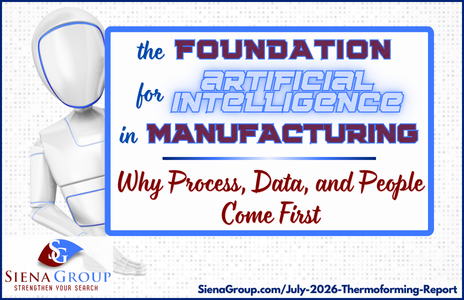
July Thermoforming Report. The Foundation for AI in Manufacturing: Why Process, Data, and People Come First

by Keith Brown, President & Owner, Siena Group
July 2026.
Happy Friday! Everywhere you look, manufacturers are talking about AI. But technology alone will not solve the challenges companies face every day on the production floor. Before AI can deliver real value, manufacturers need strong processes, reliable data, and alignment across their teams. This month’s feature article in our July Thermoforming Report explores why the fundamentals still matter, how AI can support continuous improvement, and why the best results come from using technology to strengthen an operation that is already built on a solid foundation.
As usual, we have several great articles relevant to our industry and quite a few amazing All Stars to highlight! Check them out down below in the links on the right. We have extraordinary talent that we feature and that also now includes Executive Leaders.

AI is Only as Smart as Your Operation
AI isn’t the solution – it is the enabler. It is a tool to improve operations, not a savior that’s going to fix broken ones. Like every other piece of equipment on your production floor – and every person on your team – it only delivers value when it’s used effectively.
A short but insightful Forbes article prompted this month’s topic. Forbes’ AI Won’t Fix Manufacturing Until Manufacturers Fix the Work (June 9, 2026) highlighted six places that need attention before AI can deliver real value:
- Start with a Problem Worth Fixing
- Get One Version of the Truth
- Fix the Breaks Between Teams
- Fix the Process Before You Automate It
- Bring in the People Who Know the Shop Floor
- Treat AI Like Continuous Improvement
We will dig into each one below and explore it further, but let’s discuss the upfront idea. At its core, AI still follows the old computer principle: ‘garbage in, garbage out’. The meme below pretty much sums it up.

How will AI fix manufacturing that isn’t working well to begin with?
It won’t.
Not until manufacturers invest the time to correct inherent problems first and collect the right information efficiently.
Once these fundamentals are in place, AI can dramatically improve decision-making, response time, and predict failures before they happen.
Start with a Problem Worth Fixing
BMW used AI to create a digital factory and simulated physical improvements before turning one wrench. The article said it succinctly: “Pick a problem that is already costing the business money. Then ask what has to change for the problem to improve. A good AI use case starts with operating pain, a clear owner and a result the company can measure. Otherwise, the project becomes another technology experiment looking for a reason to exist.”
A personal example I’ve shared previously is way back when, as a Process Engineer, we were fighting a pervasive problem that we couldn’t figure out. It was a high-speed nonwovens machine and when one of the compaction rolls grabbed a random part of the fabric, it was all over in a matter of 2 seconds, and we were down. High-speed cameras weren’t typically used in this type of application, but I gained approval to try something different. We were able to identify the problem and fix it. More importantly, we applied that temporary solution across the machine so that we could begin predicting failures and correcting them before they resulted in costly downtime.
AI – just like the cameras in my example – doesn’t fix the problem. It helps you identify it faster so you can fix it faster.
Get One Version of the Truth
“AI is only useful if the operation has a shared view of what is happening. Bosch’s Bamberg plant shows what that looks like. Cameras, sensors and test stations feed production data into AI-supported analysis. Most manufacturers don’t have that. They’re still living with multiple versions of the truth. One number in the ERP. Another in a spreadsheet. A third in someone’s head. AI will not reconcile that by magic. But it will force the company to decide which version is real. Bad data doesn’t become good because AI touches it. It just becomes bad data moving faster.”
Forbes
Exactly. The problem in the example above could have multiple reasons for failure. Each crew had their own ideas. The Process Engineers on the other machines had their ideas. I had my thoughts and Corporate Engineering had theirs. Capturing the right information in real time was what made the difference. No confusion. No discrepancy. Clear data that we could all agree on, look at, and collectively generate the right changes to fix root cause.
Fix the Breaks Between Teams
“Lenovo says the system cut schedule planning from two hours to two minutes and increased production volume by 19%. That kind of scheduling only works when teams are connected. Sales has to know what production can actually make. Purchasing has to know what materials are missing. Production has to know when priorities change.”
Forbes
I am working with a client that is struggling in this area, and it is generating frustration that needs to be corrected. Without alignment and constructive communication across all functions, things break down – and that all-important growth curve begins to flatten. A company doesn’t run well this way “no matter how smart the software is.”
Fix the Process Before You Automate It
This is the crux of the entire article in my opinion. The article poses the question, “Why does the work happen this way?” It gets back to good old Lean Six Sigma principles and the seven “TIMWOOD” wastes. Every production process has flaws, and the reasons are many. Why invest the time and resources in automation when you should be investing in solutions and fixing foundational problems?
“AI should not become expensive duct tape for broken workflows. The goal should be to redesign the work so better decisions become easier to repeat.“
Forbes
Bring In the People Who Know the Shop Floor
“The people doing the job know the difference between the official process and the real one. They know which data is wrong, which alerts people ignore and which “temporary” process quietly became standard practice.”
Forbes
Man, oh man, this is true! If you’ve ever spent any time on the production floor, you’ve lived this every day. During my time working on that nonwovens machine in the example above, I invested a significant amount of time gathering information to develop a centerline document that every crew could use. I had a great rapport with the manufacturing team and asked them about what worked and why. By combining their firsthand experience with my own training and engineering background, we created a practical standard that every crew could trust and follow.
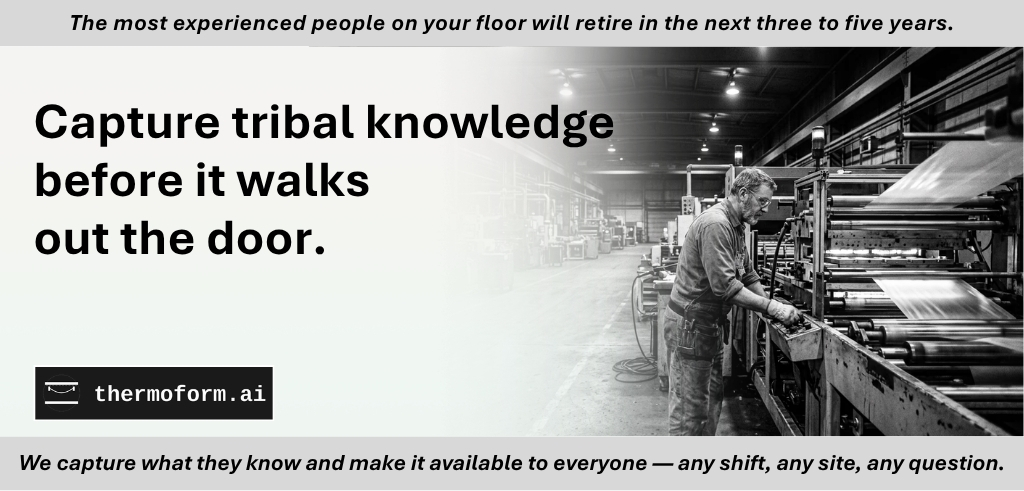
[As a side note, this is exactly what thermoform.ai strives to do: they capture tribal knowledge before it walks out the door. Check out the link in graphic at the end of this report.]
Treat AI like Continuous Improvement
“Continuous improvement is where manufacturers excel. They know how to look at a process, find what’s slowing it down, fix what’s broken, measure the result and keep improving. AI should be treated the same way. AI has to earn its place in the factory. It has to solve a real problem, work for the people doing the job and make the operation better in a way people can see.”
Forbes
The challenge is that all of the fundamentals we’ve already discussed need to be in place before AI can deliver meaningful results.
The article closes by saying, “Before AI helps a factory run smarter, it needs to show leaders what to fix under the hood.” I would argue the opposite. Before AI is implemented, leaders need to fix what’s under the hood. Then AI can do what it’s designed to do – make a well-run operation even better.
Wrapping Up
If you aren’t figuring out how to leverage AI on your production floor, you are falling behind. Just don’t make the mistake of ‘putting lipstick on a pig’ – using AI to disguise broken processes instead of fixing them. AI isn’t superficial or a cosmetic improvement. It’s a significant investment of time, money, and resources.
AI isn’t the solution. It never will be. It’s the enabler.
Give it a strong process, good data, and engaged people, and it will help you build an even stronger manufacturing operation.
The ‘check engine light’ analogy in the article really hits home. AI isn’t there to replace the mechanic. It’s there to tell you where to look first. The repair is still up to you.
At Siena Group, we are your Thermoforming Talent Partner. With more than 30 years of experience in manufacturing, hiring & recruiting talent, we bring a greater understanding of the companies we partner with and the candidates we pursue.
Let’s Strengthen Your Search!
“AI doesn’t fix the problem. It helps you identify it faster so you can fix it faster.”
Keith Brown, Owner/President, Siena Group

- This is What the U.S. Manufacturing Renaissance Actually Looks Like. via Forbes.
- 2026 State of Manufacturing & Supply Chain: AI, Resilience, and the Path Forward. via Fictiv.
- US Manufacturing Growth Continues for Sixth Straight Month. via Plastics Today.
- ‘The Walking Dead‘ Gave Me a Fresh Take on Lean Leadership. via IndustryWeek.
- Mapped: Which U.S. States Depend Most on Manufacturing? via Visual Capitalist.
- Huge Companies Team to Create Recycled-Content Change in Small Packaging. via Plastics News.
- HBR’s Favorite Management Tips on Decision-Making. via Harvard Business Review.
- AI Boom Reshapes Chemical M&A Landscape. via Plastics Today.
- Facing ‘Major Challenges’ with Plastics, California Debates Extending EPR Deadlines. via Plastics News.
- The Manufacturing Workforce Isn’t Missing—It’s Mislabeled. via IndustryWeek.
- Plastics M&A Looking to Rev Back Up in Second Half. via Plastic News.
- Industrial AI Will Fail Without a New Pricing Model. via IndustryWeek.
- AI Investment Accelerates in Medical Plastics. via Plastics Today.
- Exploring Lean Myths – Myth 1: Lean Is Easier to Implement Outside of the United States. via IndustryWeek.
- Anchor Packaging, Pizza Hut Recognized for Sustainable PP Wing Bowl. via Plastics Today.
- Research: AI is Changing What Employers Want from New Hires. via Harvard Business Review.
- New PMMI Report Reveals Sustainability Is Reshaping Equipment Requirements Across the Packaging and Processing Industry. via Packaging Technology Today.
- June ISM Report: Manufacturing Activity Expands for Sixth Straight Month. via IndustryWeek.
- Workforce Expert Urges New Framework for ‘Technician Economy’. via PMM.
- Resin Prices Rise as Geopolitics Reshape Plastics Supply. via Plastics Today.
- Material Insights: Is Another Polyethylene Price Drop Coming? via Plastics News.
- Resin Pricing: PE Prices Drop 15 Cents in June. via Plastics News.
- Resin Price Report: Buyers Face Closing Window on Pricing Leverage. via Plastics Today.
- Market Reports: Plastics by the Numbers. via Plastics Today.
- Mergers & Acquisitions Tracker. via Plastics News.
- BLS Employment Report – June 2026. via Dept of Labor.

- Why Executive Teams Fail to Execute: The Alignment Trap
Leadership alignment isn’t about everyone agreeing – it’s about ensuring everyone is committed to the same path forward. This article explores how “false alignment” at the executive level can derail transformation efforts and offers practical steps for building true agreement that leads to better execution and stronger business results. via Siena Group. - Why Emotional Intelligence Matters More Than Technical Skills In The AI Age
As AI continues to reshape the workplace, human-centered skills like emotional intelligence, communication, and adaptability are becoming increasingly valuable. This article examines why “power skills” are emerging as critical hiring and leadership priorities – and how companies can develop these capabilities through intentional hiring, mentorship, and employee growth opportunities. via Forbes. - Mapped: America’s Economic Landscape, by the Numbers
These Visual Capitalist graphics examine both the distribution of U.S. GDP by state and the states experiencing the strongest economic growth. Together, they reveal how established economic powerhouses continue to generate the largest share of output while emerging growth regions – particularly across the Sun Belt – are fueling the nation’s next wave of expansion. via Visual Capitalist: GDP Share & GDP Growth. - Why Leaders Should Run Experiments Before Rolling Out Big Changes
As businesses navigate rapid technological and operational shifts, the ability to test, learn, and adjust is becoming a competitive advantage. This article addresses ways leaders can embrace experimentation before implementing large-scale changes, helping organizations avoid costly missteps and adapt faster. via CEO Magazine. - Are Your Job Postings Driving Away Creative Talent?
The language companies use in job postings can influence the quality and diversity of applicants they attract. This article examines how shifting from “genius” language to a focus on curiosity, exploration, and collaboration can help organizations connect with more innovative talent. via Harvard Business Review.

Senior Process Engineer/Production Manager: This accomplished Manufacturing Leader brings more than 20 years of thin-gauge thermoforming experience, combining deep technical expertise with proven leadership across production, process engineering, extrusion, maintenance, and operations. Having advanced from Set-Up Technician to Manufacturing Manager, he is recognized for developing high-performing teams, improving OEE, reducing waste, and solving complex manufacturing challenges, and is seeking a leadership opportunity with a people-focused organization that values operational excellence and culture.
Operations and Product Development Leader: This versatile Technical/Operations Leader brings more than 30 years of experience spanning thermoforming, tooling, product development, and operations across both heavy and thin gauge plastic packaging. With a unique foundation as a toolmaker and tooling business owner, he has consistently improved manufacturing performance, accelerated new product launches, and partnered with customers to develop scalable production solutions, and is seeking a leadership role where he can leverage both his technical and operational expertise.
National Account Manager: This proven Commercial Leader brings more than 30 years of experience driving growth across pharmaceutical, food & beverage, consumer packaging, and engineered plastics markets. Combining deep thermoformed packaging expertise with strategic account management and business development success, he has consistently expanded key customer relationships, launched complex packaging programs, and delivered multimillion-dollar growth, and is seeking a stable organization where he can leverage both his technical and commercial strengths.
Manufacturing Director: This distinguished Manufacturing Executive brings more than 25 years of experience leading multi-site operations across packaging, plastics, and thin-gauge thermoforming environments. With full P&L responsibility, Lean Six Sigma Black Belt certification, and a track record of improving EBITDA, OEE, safety, and customer performance, he excels at driving operational turnarounds, building high-performing teams, and is seeking a stable, growth-oriented organization where he can make a lasting impact.
Design Engineer: This innovative Packaging Engineer brings more than 25 years of experience designing thin-gauge thermoformed packaging solutions from concept through production. Combining strong mechanical engineering expertise with creativity and practical manufacturing knowledge, he has developed five patented packaging designs and is recognized for creating innovative, manufacturable solutions that meet both customer and production requirements.
Even More Thermoforming Talent! We work with so many talented people in many different functions – all in thermoforming. Whether it’s an Operations Leader, Plant Manager, Supply Chain Leader, HR Leader, specialized Engineer, Quality Leader, Sales Leader, or pretty much any thermoforming role, we are here to help. Check out our Executive Showcase, our custom listing of high-level senior leaders who are fully vetted and confidentially seeking a new opportunity. If you have a need, please do not hesitate to reach out!
Click for more All-Stars + our new Executive Showcase.
Share our post with others
Love what you see? Share it with your connections now.