
August Thermoforming Report: Counteroffers – A Manager’s Perspective

by Keith Brown, President & Owner, Siena Group.
August 2025.
Counteroffers are a topic near and dear to every person involved in talent management. And yes, that pretty much means everyone! Counteroffers are the bane of Recruiters and Talent Professionals because we understand their implications better than most and certainly better than employees seeking a change. I dig into this topic below from both sides of the desk, and though it isn’t new information, it certainly provides good reminders of the risks and realities we often face.
As usual, we have several great articles relevant to our industry and quite a few amazing All Stars to highlight! Check them out down below in the links on the right. We have extraordinary talent that we feature and that also now includes Executive Leaders.
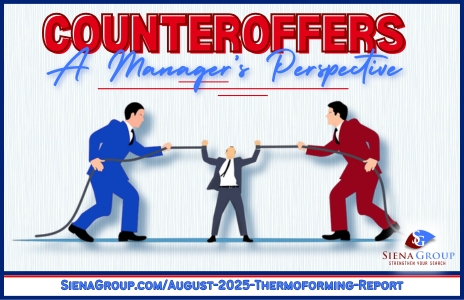
A Manager’s Perspective
Counteroffers. They’re a hot topic – surrounded by a flurry of statistics, success stories, and cautionary tales. How many are offered? How many are accepted? How long do employees stay afterward? What are the impacts? The numbers vary, and when you try to pin down their sources, things quickly get murky. Still, some of the commonly cited data – though dated – continues to ring true.
Yes, the employment market dynamics are always changing and evolving, especially in manufacturing. But despite the shifting landscape, there are some consistent truths about counteroffers that deserve attention. This article isn’t about crunching every stat or trend. Instead, it’s about sharing practical insights from the perspective of a Manufacturing Leader– someone who’s made counteroffers, watched them play out, and learned a few hard truths along the way.
The Numbers
Let’s start with what most in the hiring world already accept as common knowledge. (No, I don’t have a perfect study to cite – but if you’ve worked in talent or management for any length of time, you’ve probably seen these stats prove true):
- Half of employees who accept a counteroffer are actively job hunting again within 60 days.
- 8 out of 10 employees who accept a counteroffer are gone within 6 months.
- 9 out of 10 employees are gone within 12 months – whether by their own choice or their employer’s.
A SHRM article from a few years back shares these stats:
“The research shows that accepting counteroffers can harm your career. Almost 60 percent of hiring managers agree that any employee can be replaced, and 45 percent said they perceive counteroffers as a short-term cure for a long-term problem.
While most people managers don’t embrace the practice, they do admit to using counteroffers from time to time as a retention tool. That said, 37 percent said that extending counteroffers sets a bad precedent; 34 percent said it erodes employee trust; and 30 percent said it negatively impacts employee morale.”
The Manager’s Point of View
As a former manager, I’ve made counteroffers – and had a couple accepted. One situation in particular, though it happened years ago, still echoes many of the recruiting conversations I hear today. The employee was frustrated with [fill in the blank], enough that he started looking elsewhere. When he came to me to resign (which was interesting, since he technically reported to one of my managers), I knew I had a problem on my hands.
This guy was good – technically sound, took initiative, worked safely and reliably. So, I made a counteroffer to keep him, and he reluctantly accepted. All was done genuinely – I promised to work on his concerns, and he was going to hang in. It felt like the right move at the time.
Did my view of him change? No… but yes. He had valid frustrations, and I respected that. But I also now saw him as a flight risk – and that meant I had to protect the team. I started searching for his backfill almost immediately, just in case.
Was I able to fix the issues that made him want to leave? A little… but not enough. Some things were out of my control, and even the things I could address weren’t resolved to the extent he’d hoped for.
Here’s what I learned from that experience:
- Did I fault him? No. But I couldn’t ignore the fact that he might leave again – and soon.
- Did it impact his career? Maybe. Because of the now-known flight risk, we didn’t assign him to a high-stakes project. We just couldn’t chance him leaving mid-stream, and that meant he missed out on growth and visibility.
- Did the counteroffer buy me time? Absolutely. For a relatively small increase in pay, I kept the team whole while quietly preparing for his departure.
- Did I fix the root problem? Not really. We made some progress, but not enough to shift his long-term outlook – or mine.
These situations take a toll – not just on the employee, but on the manager too. You’re juggling the need to retain talent, protect the team, and deliver results, all while knowing trust has been quietly eroded on both sides. It’s a balancing act between empathy and business reality – and it’s never easy.
The Employee’s Point of View
Change is hard, and changing jobs is definitely harder… especially if that change also includes relocating. By the time someone gets to the point of seriously considering a new opportunity, it usually means they’ve been unhappy for a while. So why do more than 50% of people choose to stay when given a counteroffer?!? Honestly, that’s a tough question to answer!
- The obvious answer? Because change is hard. Walking away from what’s familiar takes courage. Relocating is disruptive. Accepting a counteroffer, by contrast, feels easy. It’s a quick fix that promises more money, maybe more responsibility – and the comfort of staying put.
- In the moment, it can feel like a win. You were undervalued or underpaid, and now that’s been “corrected”. But often, that sense of victory is short-lived.
- There’s also the emotional complexity. You might feel obligated – to the company, your colleagues, your family, or even some sense of your self-worth. Maybe you genuinely like the company or your manager or your team, and don’t want to put them in a pickle. Maybe you feel that leaving reflects poorly on you or them. So you stay.
Here’s the truth: accepting a counteroffer is a temporary fix. It rarely addresses the root issues that led you to look elsewhere in the first place! What’s worse, if you accept a promotion or raise as part of the counter, you might feel empowered to drive change – only to find yourself held to a higher standard, while the same frustrations linger. In many cases, those issues become even more magnified.
Key Takeaways
For Employers and Hiring Managers:
- Seek to understand why someone is leaving. Dig into the root causes, not just the symptoms, to prevent further turnover.
- Build a culture of trust and open communication. Retention isn’t about reactive counteroffers – it’s about proactive leadership! If someone’s already out the door mentally, a pay bump won’t keep them long. Seek to make lasting and real changes to help your team want to be there.
- Part ways with professionalism. Be courteous, encouraging, wish them well – and leave the door open. We live in a small community of thermoforming manufacturing. You never know when you will work together again!
For Employees and Candidates:
- Be respectful – but say no. Thank your manager for the counteroffer, but graciously decline.
- Do not forget that accepting a counteroffer means turning down a great new role! New jobs with good organizations don’t just happen. That offer you accepted elsewhere didn’t come easily! It likely represents greater opportunity, better alignment, and a company that values what you bring to the table now – not just when you’re ready to leave.
- Understand the risk of staying. If something happens in the organization, a financial downturn or an acquisition or a reorganization, who’s most at risk? Often, it’s the person who’s already signaled their intent to leave.
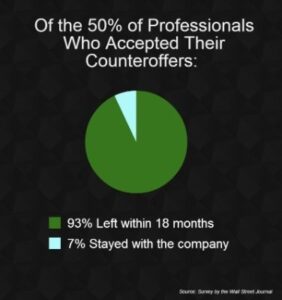
- Know the odds. While there are always exceptions, most who accept counteroffers end up leaving anyway. Ask yourself: will you be a part of the 93% who leave anyway – or the rare 7% who make it work? [from the Wall Street Journal graphic below]
Wrapping It Up
At the end of the day, counteroffers are a short-term solution to a deeper, often long-standing issue.
From a manager’s perspective, they can buy time – but rarely buy loyalty. From an employee’s perspective, they can soothe discomfort – but rarely solve the problem.
If you’ve reached the point where you’re ready to leave, trust that instinct. Accepting a counteroffer may feel like the safer path in the moment, but more often than not, it delays the inevitable and can quietly derail your growth, reputation, and trajectory. Whether you’re leading a team or navigating your own career, the real win lies in having the courage to make lasting decisions – not convenient ones.

As your Thermoforming Talent Partner, we represent clients AND candidates! We’re here to help in any and every way possible! We provide hiring strategies, priority candidate searches, job searches, client & candidate introductions, interview tips, résumé facelifts, resignation strategies, and much much more. LET’S STRENGTHEN YOUR SEARCH!
“Here’s the truth: Accepting a counteroffer is a temporary fix. It rarely addresses the root issues that led you to look elsewhere in the first place.”
Keith Brown, Owner/President, Siena Group

- Transforming the Food Supply Chain: How Tosca’s Reusable Packaging Solutions Touch Every Meal. via Packaging Reporter.
- UFP Technologies Expands Medical Manufacturing Portfolio. via Plastics Today.
- All Things Data: Processor, Recycler, and Mold Maker Rankings. via Plastics News.
- Research: The Hidden Penalty of Using AI at Work. via Harvard Business Review.
- Manufacturers Aren’t Ready for Work Coming Back to US. via IndustryWeek.
- Provisions in New Tax Law Could Boost Plastics Processors. via PMM.
- Canada’s E. Hofmann Expands to US with $43M Plant. via Plastics News.
- What Ford Taught Me About Fixing America’s Supply Chain. via Forbes.
- Resin Pricing: North American PP Prices Take a Dip in July. via Plastics News.
- Sustainable Alternative to Fossil Plastics Emerges for Cosmetic Applications. via Packaging Reporter.
- Medical Thermoforming: Quality Control Best Practices. via Plastics Today.
- Material Insights: Feedstock Costs Push Prices for PP, PS in Opposite Directions. via Plastics News.
- Tapping into Neuroscience to Lead Through Turbulence. via IndustryWeek.
- Plastics Industry Urges Countries to be ‘Realistic’ in Treaty Talks. via Plastics News.
- Trustworthiness and Compliance: Shifting the Marketing Mindset. via CEO Magazine.
- Plastics by the Numbers: Current Market Report Slideshow. via Plastics Today.
- Price Resin Report: Most PP, PE Grades Lost a Penny in July. via Plastics Today.
- ISM Report: Manufacturing PMI Contracts at a Faster Rate in July. via IndustryWeek.
- Mergers & Acquisitions Tracker. via Plastics News.
- BLS Employment Report – July 2025. via MRINetwork.

- The Best Kept Secrets in Interviewing
Interviewing well isn’t just about ‘knowing your stuff’… it’s about knowing how to show it! This article – Part 2 in a series – reveals advanced strategies that help candidates elevate their performance and stand out in today’s competitive job market. via Siena Group. - Valuing Employees is the ‘REAL’ Blueprint for Retention
This month’s main article points out the issues of great employees becoming unsatisfied with their current employer. Employees don’t stay at companies because of free coffee or beautiful spaces – they commit when their emotional, professional, and psychological needs are met. This article addresses the deeper needs that truly anchor people to an organization. via Forbes. - 2025 Thermoformed Packaging Analysis & Outlook Market Report
The only market report dedicated exclusively to thermoforming! This report provides a comprehensive analysis of the thermoforming market, outlining key growth drivers, competitive dynamics, and investment considerations for industry stakeholders. It also offers several industry case studies, covers specific M&A transactions, and includes perspectives on supply-side technologies, recycling mandates, Europe and global markets. via ClefsAdvisory. - Leadership: Now is the Time for Courage
Research shows that courage – not caution – drives success, even in uncertain times, and it can be learned. This article uncovers five strategies used by brave individuals, reinforcing the idea that bravery is a skill anyone can develop by studying the actions of bold leaders, whistleblowers, and everyday heroes. via Harvard Business Review. - Revving Up the US Technology Engine
The United States is facing a new “Sputnik moment,” with national initiatives aiming to drive innovation in key technologies to maintain global competitiveness and security. This article emphasizes the urgency of revitalizing U.S. technology leadership through coordinated national effort and strategic investment. via Forbes.

Packaging All-Star: This 30-year Packaging Vet brings an all-star combination of skills, including Technical Sales Engineer, NPD Project Leader, Product Cost and Profitability Guru, and Senior Design Engineer. He has a strong ability to understand all business financials and manage a high number of projects. He is located in the Chicagoland area and is available for remote roles as well.
Sales Director: This Sales Leader brings over 15 years of packaging experience and currently oversees sales across the western U.S., with a history of managing up to $100M in revenue. Known for turning around underperforming teams and driving top-line sales, he is open to roles in the West, Chicago, or Minneapolis.
Plant Manager (thin-gauge): Bringing more than 15 years in thin-gauge thermoforming, with 10 of those years at the Plant Manager level, this up-from-the-ranks leader brings a very high level of technical knowledge in thermoforming and extrusion, and in processing and maintenance. His strengths are providing stability and improving the culture of the team.
Executive Showcase: Sales Executive: This seasoned 25+-year Senior Vice President of Sales brings a strong track record of revenue growth, margin improvement, and team transformation across global, complex organizations. With full P&L ownership, a customer-centric mindset, and a servant leadership style, he’s now seeking an SVP or CRO role where he can drive both top-line growth and profitability.
Even More Thermoforming Talent! We work with so many talented people in many different functions – all in thermoforming. Whether it’s an Operations Leader, Plant Manager, Supply Chain Leader, HR Leader, specialized Engineer, Quality Leader, Sales Leader, or pretty much any thermoforming role, we are here to help. Check out our Executive Showcase, our new listing of high-level senior leaders who are fully vetted and confidentially seeking a new opportunity. If you have a need, please do not hesitate to reach out!
Click for more All-Stars + our new Executive Showcase.
At Siena Group, we are your Thermoforming Talent Partner. With more than 30 years of experience in manufacturing, hiring & recruiting talent, we bring a greater understanding of the companies we partner with and the candidates we pursue.
Let’s Strengthen Your Search!
Share our post with others
Love what you see? Share it with your connections now.