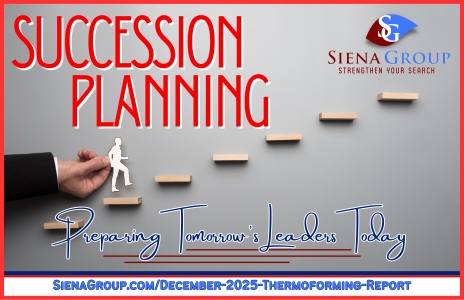
December Thermoforming Report: Succession Planning – Preparing Tomorrow’s Leaders Today

by Keith Brown, President & Owner, Siena Group.
December 2025.
Let’s face it. The staffing challenges from our September Thermoforming Report, The Great Hand-Off – Managing Generational Turnover, aren’t going away! Baby Boomers are retiring, Gen X is moving into late-career stages, and Millennials and Gen Z now make up the majority of the workforce.
That’s why Pillar Three – Succession Planning, the final installment in our Harvesting Potential series – is more important than ever. This month’s Thermoforming Report shows how organizations can build a culture of succession, preparing tomorrow’s leaders today while keeping your strongest talent engaged, growing, and ready for what’s next.
As usual, we have several great articles relevant to our industry and quite a few amazing All Stars to highlight! Check them out down below in the links on the right. We have extraordinary talent that we feature and that also now includes Executive Leaders.
We’ve spent the past few months exploring what it really takes to grow a strong, future-ready organization from the inside out. In our Harvesting Potential series, we’ve looked at three interconnected pillars: Retention, Career Development, and Succession Planning. The connection between these pillars is clear – each relies on and reinforces the other.
Now it’s time to wrap up this series by turning the spotlight to Pillar Three: Succession Planning – Preparing Tomorrow’s Leaders Today.
And to continue the ‘harvesting’ metaphor: if retention and development create the soil and nutrients for growth, succession planning is the trellis – the structure that ensures your people have somewhere to grow into.
More Than Filling a Role
For many companies, succession planning is still viewed as a reactive process. A key leader announces retirement. A manager resigns unexpectedly. A critical technical expert walks out the door. Suddenly, the scrambling begins.
But true succession planning isn’t reactive at all – and it’s certainly not just a chart with names in boxes. The most successful organizations treat succession planning as a continuous culture, not a one-time exercise.
A great Forbes article, Succession Planning: Building Something That Lasts Beyond You, puts it succinctly:
“Succession isn’t a document or a meeting topic, but a mindset. It’s embedded in how we hire, delegate and grow. Employees want to know there’s a future for them beyond current leadership—that the company is a place where they can build long-term careers.”
Recent insights from that Forbes article – along with Harvard Business Review’s The Pitfalls that Undermine CEO Succession Planning – echo the same message: Succession planning must be proactive, ongoing, and deeply personalized to each individual’s potential. As Forbes notes: “Without a clear plan, even the strongest teams can find transitions harder than expected.”
And that’s the key shift: Succession Planning is not about predicting turnover – it’s about preparing talent.
A Lesson from the Field
I’ve shared this story in earlier installments, but it perfectly illustrates the heart of this pillar. Early in my career at Kimberly-Clark, I had the privilege of experiencing a succession culture done right.
Once a year, the VP of Engineering and his senior leaders traveled to every single plant – not to check KPIs or conduct performance reviews, but to sit down with every engineer one-on-one and talk about their career: what we wanted to learn next, where our strengths were growing, and which roles could stretch us.
That level of personal investment left a lasting impression. I didn’t just feel evaluated – I felt seen. I felt like the company had a plan for me long before I had one for myself. And because of that, I wasn’t looking anywhere else.
That is the quiet power of succession planning: It creates loyalty long before a promotion ever happens.
What Effective Succession Planning Actually Looks Like
That experience taught me that effective succession isn’t accidental – it’s built with intention. And the research agrees. A recent Harvard Business Review article points out that strongest succession efforts share one defining element: a trusted, engaged CHRO who brings structure, objectivity, and clarity to the process. Across industries and company sizes, the organizations that excel at succession planning consistently do a few things exceptionally well:
- They Start Early. Succession planning doesn’t begin when someone gives notice – it begins the moment someone shows potential. Great leaders see talent not as it is, but as it could be. As the Forbes article notes: “When you grow talent from within, transitions happen more naturally, and it sends a message that the firm invests in its own people.”
- They Develop for Multiple Futures. Career paths are rarely linear anymore. Strong succession plans prepare people for a multiple future scenarios – broader roles, lateral shifts, leadership responsibilities, and deeper technical expertise.
- They Tie Succession to Development. This is where Pillars Two and Three intersect. Internal development builds capability; succession planning directs that capability toward what the organization needs next.
- They Make It Personal. Check-the-box succession planning misses the mark. The most effective organizations design individual growth plans around each person’s strengths, motivations, and aspirations – not generic, cookie-cutter tracks.
- They Hold Leaders Accountable. Succession isn’t an HR task – it’s a leader’s responsibility. When leaders are evaluated on how well they grow future leaders, succession becomes strategic, not optional.
- They Communicate with Transparency. No one needs guarantees – but they do need visibility. Transparency about possibilities builds trust. Silence creates turnover. As Forbes put it, “Transparency keeps people grounded. Talking openly about leadership development builds trust across the organization.”
When Succession Planning Becomes Culture
Here’s the simple truth we see again and again with our clients: The strongest organizations develop successors long before they need them. Not because they’re trying to fill gaps – but because they’re committed to growing people.
Succession planning becomes part of everyday leadership, not an annual exercise completed out of obligation. It shows up in the small, consistent moments: the performance conversations where leaders talk about what’s next, the development plans that stretch skills, the mentorship pairings that build confidence, and the cross-functional experiences that expand perspective.
It’s reinforced through leadership visibility and intentional coaching – the daily behaviors that communicate, “We believe in your future enough to prepare you for it.”
Wrapping Up
The best succession plans start long before someone leaves. They begin the moment leaders start investing in what’s next – not out of fear of loss, but out of belief in potential.
As the Forbes article emphasizes (yes, it’s a great article): “The day you start thinking you’re irreplaceable is the day you start holding your company back. Leadership isn’t about holding onto control; it’s about preparing others to lead. And part of that is contingency planning—knowing who’s next in line if circumstances change.”
Succession planning isn’t about endings. It’s about continuity. It’s about strengthening culture. And most importantly – it’s about building the future through the people you already have.
Bringing it ALL Together
As we close this three-part series, one theme rises above the rest: Growing tomorrow’s leaders from within isn’t a program – it’s a mindset.
- Pillar One: Retention keeps great people.
- Pillar Two: Internal Development grows them.
- Pillar Three: Succession Planning prepares them for what’s next.
Just like any great harvest, cultivating leaders takes patience, intention, and consistency – season after season. And the organizations that plant those seeds today will reap the strongest, most resilient teams tomorrow.
As your Thermoforming Talent Partner, we represent clients AND candidates! We’re here to help in any and every way possible! We provide hiring strategies, priority candidate searches, job searches, client & candidate introductions, interview tips, résumé facelifts, resignation strategies, and much much more. LET’S STRENGTHEN YOUR SEARCH!
“Succession planning isn’t about endings. It’s about continuity. It’s about strengthening culture. And most importantly – it’s about building the future through the people you already have.”
Keith Brown, Owner/President, Siena Group

- Printpack Shutters Elgin Facility, Cuts 111 Jobs. via Plastics Today.
- Salt Lake City Thermoforming Adds More Clean Room Capacity Through Expansion. via Plastics News.
- How Children Can Teach Us to Celebrate the Small Wins. via CEO Magazine.
- Resin Pricing Report: Recycled Resin Markets Tread Water in November. via Plastics Today.
- MSU Researchers Develop Easier-to-Recycle Multilayer Plastics. via Packaging Technology Today.
- New Positives of Plastics Website Sets the Record Straight on Much-Maligned Material. via Plastics Today.
- All Things Data: Processor, Recycler, and Mold Maker Rankings. via Plastics News.
- Flexible Packaging November Driven by Research and Investment. via Plastics Today.
- Poor Hiring Data Points to US Economic Weakness. via IndustryWeek.
- Georgia to Ban Certain Single-Use Plastics from 2026. via Eco-Plastics in Packaging.
- Resin Pricing: Prices Down for North American PP Resin in November. via Plastics News.
- Rigid Plastic Packaging Firm to Shutter NC Plant. via Plastics Today.
- The Strength of Soft Skills. via Plastics News.
- How US Employers Can Meet the Healthcare Needs of Younger Workers. via Harvard Business Review.
- AI Shapes the Future of Resin Selection. via Plastics Today.
- ISM Report: Manufacturing PMI Falls Slightly to 48.2% in November. via IndustryWeek.
- Mergers & Acquisitions Tracker. via Plastics News.
- BLS Employment Report – November 2025. [The publication of November’s BLS report is delayed; will be active 12/16/2025.]

- Internal Development: Growing Leaders from Within
When leaders grow their people, organizations grow with them. This article – the final installment in our Harvesting Potential series – explores how internal development fuels retention, strengthens culture, and builds momentum from the inside out – showing why teams thrive when leaders stay present, purposeful, and committed to long-term growth. via Siena Group. - 5 Key Succession Planning Failures and Strategies for Achieving Success
Dovetailing with our main Thermoforming Report article, this article addresses the pitfalls of traditional succession planning. Companies must focus on engaging potential leaders through development programs that not only enhance their skills but also strengthen their commitment to the organization. via Forbes. - Great Leaders Empower Strategic Decision-Making Across the Organization
What separates scalable organizations from stalled ones? This HBR article shows how great leaders drive success by building decision-making systems others can use – instead of relying on heroic, top-down calls. via Harvard Business Review. - Why CEO Turnover is Rising in 2025
CEO transitions are rising even among top performers as boards confront a volatile, AI-driven, “new normal.” This article explains why succession planning is shifting from a reactive event to a continuous, strategy-driven process. via CEO Magazine. - Finding Focus in a World Addicted to Distraction
High performers move through a distracted world with clarity and calm because they engineer their focus, not rely on willpower. This article breaks down the systems and habits that fuel their discipline and long-term success. via CEO Magazine.

Executive Showcase: VP of Operations: This proven Operations & Engineering Executive brings 30+ years in plastics and thin-gauge thermoforming. He’s led multi-site operations and startups, delivering major gains in quality, productivity, and cost savings in the millions. A results-driven leader who builds ownership, accountability, and reliability, he’s ready to strengthen operations for a growing organization.
Business Development Manager/Regional Account Manager: This accomplished Sales Leader brings 30 years of sales experience – all in foodservice rigid packaging. He’s consistently delivered results across his wide base of clients, supporting a ~$50M revenue region. He’s all about building rapport within a client base and increasing share & value – in a targeted regional approach.
Production Manager (heavy + thin gauge): This up-from-the-ranks Production Leader brings technical expertise in both heavy and thin gauge thermoforming, with experience in heavy-gauge equipment, both inline and roll-fed machines, and extrusion. Bringing tremendous value, he is fully bilingual in Spanish & English and is willing to relocate.
Even More Thermoforming Talent! We work with so many talented people in many different functions – all in thermoforming. Whether it’s an Operations Leader, Plant Manager, Supply Chain Leader, HR Leader, specialized Engineer, Quality Leader, Sales Leader, or pretty much any thermoforming role, we are here to help. Check out our Executive Showcase, our custom listing of high-level senior leaders who are fully vetted and confidentially seeking a new opportunity. If you have a need, please do not hesitate to reach out!
Click for more All-Stars + our new Executive Showcase.
At Siena Group, we are your Thermoforming Talent Partner. With more than 30 years of experience in manufacturing, hiring & recruiting talent, we bring a greater understanding of the companies we partner with and the candidates we pursue.
Let’s Strengthen Your Search!
Share our post with others
Love what you see? Share it with your connections now.